Answer engine optimization (AEO) is the practice of structuring your content and online presence so AI tools like ChatGPT, Perplexity and Google AI Overviews cite or recommend your business when buyers ask questions. That is the definition. The rest of this article is how to do it as a small business, in one week.
Quick background on me: former Big4 corporate finance, now I install AI into small-business marketing and document the whole process in public.
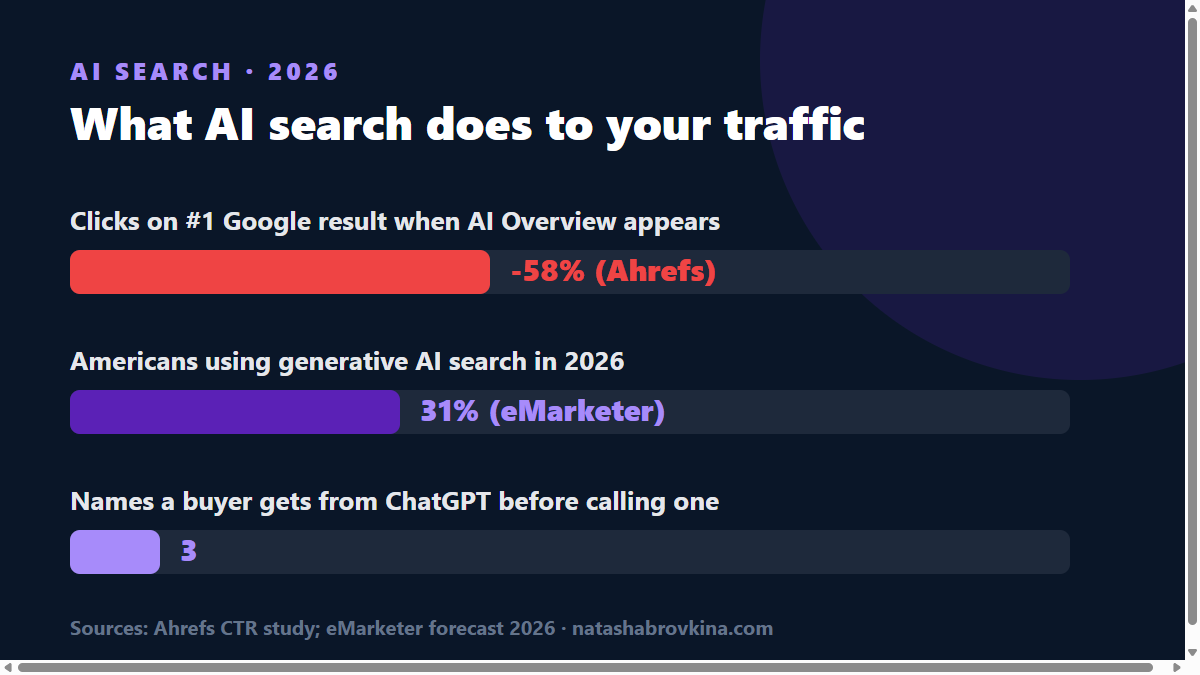
Why this matters in 2026, in three numbers
1 in 3. Nearly a third of Americans will use generative AI search in 2026, according to eMarketer. Your buyers are already part of that third.
58%. Ahrefs found that when an AI Overview appears above Google results, clicks on top organic results drop by 58%. Ranking first no longer guarantees the visit.
3. That is how many names a buyer typically gets when they ask ChatGPT who to hire. This is the new first page. It is ten times shorter than the old one.
How AI engines decide who to recommend
Language models do not rank pages the way classic search does. They cite sources they can parse and trust. In practice that means four things.
Clear definitions and direct answers. If no page on your site answers a customer question in the first two sentences, there is nothing to quote.
Real numbers. "We reply within 40 seconds" gets cited. "High quality and individual approach" never does.
Consistent identity. If you are a "consultant" on LinkedIn, an "agency" on your site and a "studio" in directories, the model sees three different entities. One name, one description, everywhere.
Presence where models read. For US models that is Reddit, industry comparisons and review sites. Communities are now the top cited source category in AI answers.
The 7-step week-one plan
- Run the visibility check yourself. Ask ChatGPT and Perplexity five questions your buyers actually ask ("best X in Y", "who should I hire for Z"). Write down who gets named instead of you and which sources are cited. That list is your real competitor map.
- Build one definition page per customer question. First paragraph: the direct answer in 2-3 sentences. Then details, numbers, examples.
- Add an FAQ with FAQPage schema (JSON-LD). The cheapest way to hand a model ready question-answer pairs.
- Align every mention of your business. Site, socials, maps, directories: same name, same one-line description, cross-linked.
- Publish one piece with original data. Your own numbers, a small study, a real case with figures. Original research gets cited several times more often than commentary.
- Show up where models read. Answer 3-5 live questions in your niche communities. Substance, not ads.
- Re-run the check in 30 days. Same five questions, same protocol. AI indexes refresh faster than classic SEO, so you will see movement in weeks.
A bug I found in my own funnel
I ran this exact protocol on my own sites on July 2, 2026. Found a hole I had missed for a month: my product homepage sold "AI marketing for small business" while the audit button led to a page written for accounting firms. I had changed niches in June and forgotten the page. Every lead from the homepage landed on the wrong offer.
For AI search this is a double hit. The model sees two conflicting descriptions of one business and cannot resolve the entity: marketing or accounting? A site like that gets cited for neither.
You cannot see your own site. A written protocol catches what familiarity hides.
Second find from the same audit: the "Watch on YouTube" link on my English page pointed to my Russian-language channel. Small for a human, another entity mismatch for a model.
A small study: the demand is already measurable
Before writing this piece I pulled search volume data via vidIQ (July 2, 2026, worldwide YouTube search, monthly):
- "claude seo": 202,000 searches per month, low-medium competition
- "ai seo": 140,000, medium
- "generative engine optimization": 53,000, low
- "answer engine optimization": 40,000, low
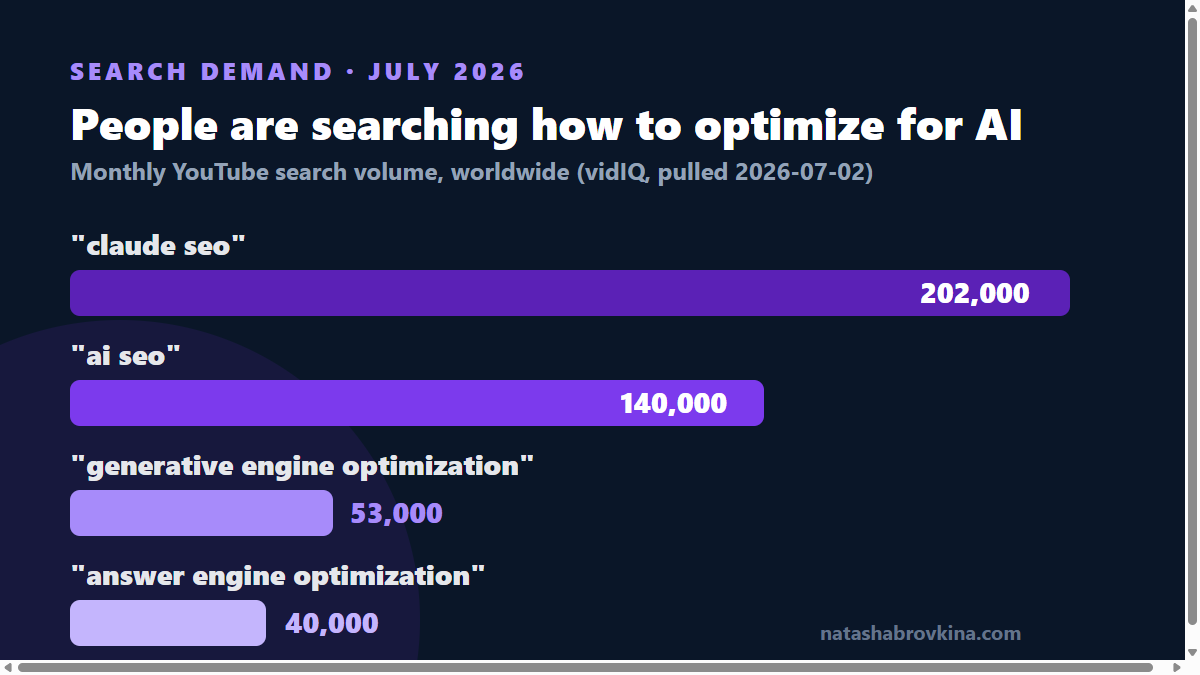
Two takeaways. Demand is already in the hundreds of thousands of monthly searches while content competition stays low: the window is open. And people search for tool-specific phrases ("claude seo"), not abstract theory. Practical, tool-level content wins the moment.
What does not work
Keyword stuffing: models read meaning, not density. Bought backlinks from link farms: sources without traffic and reputation do not make it into training or retrieval. Robot-first pages: if humans bounce, models discount the source too.
Self-audit checklist
- I know who AI recommends for my five key buyer questions
- At least 3 pages answer a question directly in the first paragraph
- FAQ with FAQPage schema is live
- My business name and description match across every platform
- At least one published piece contains my own data
- A repeat check is on the calendar 30 days out
FAQ
What is answer engine optimization?
AEO is structuring content so AI assistants extract and cite it when answering user questions. It complements SEO rather than replacing it.
Is AEO different from GEO?
In practice they overlap almost completely. GEO (generative engine optimization) emphasizes being cited in generated answers; AEO emphasizes being the extracted answer. Same work.
How long until results?
First movement in 2-4 weeks: AI search indexes update faster than classic crawling. Full effect: a quarter.
Does classic SEO still matter?
Yes. AI engines lean on well-structured, authoritative pages. AEO is a layer on top of SEO fundamentals, not a replacement.